







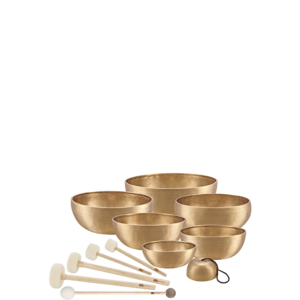
The Complete Guide to Metal Singing Bowls
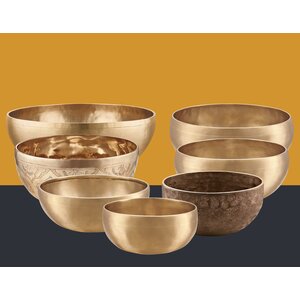
Singing bowls come in a wide variety of sizes, shapes and materials, each producing its own unique sound and resonance. For beginners in particular, it can be difficult to know which bowl is the right choice.
In this article, we focus on traditionally crafted metal singing bowls, explaining the key factors that define their sound and quality.
Read on to learn more about their origin, quality criteria, craftsmanship, playing techniques, and how our different series are designed for specific applications.
Not sure which singing bowl is right for you? Our buying guide at the end will help you find the perfect match.
The exact origin of the so-called Tibetan singing bowls has not been conclusively established1,3. However, it is widely accepted that they originate from the Himalayan region, particularly from areas such as Nepal and India, while only a small proportion actually comes from Tibet1,2,3,4.
There are various theories regarding the history and original purpose of singing bowls5. They are often believed to have been used in spiritual or ritual practices2,4. Other sources suggest that they were used in everyday life, for example, as tools for food preparation or as kitchenware2,6.
Today, singing bowls are best known for their distinctive sound and their use in meditation and sound therapy7.
Most of the singing bowls available today are produced in Nepal or India1. The term “Tibetan” only became established later and is now used more as an umbrella term for a range of similar instruments1.

High-quality singing bowls can primarily be recognized by their craftsmanship, sound, and the materials used.
One key feature is the handcrafted production process. Many high-quality singing bowls are made by hand using traditional blacksmithing techniques, making each bowl unique. Small dents, slight unevenness, or subtle variations in color are not flaws, but rather signs of authentic craftsmanship.
Another important factor is the sound. High-quality singing bowls produce a clear, stable fundamental tone accompanied by rich harmonic overtones. The sound spreads evenly throughout the room and lingers long after the bowl has been struck. In many cases, the vibrations are not only audible but can also be felt physically as gentle resonances.
The material also plays a crucial role. High-quality singing bowls are typically made from carefully balanced metal alloys, which significantly influence their sound character, resonance, and durability.
The Production of Singing Bowls
The production of singing bowls involves several complex steps, which are outlined here in simplified form. Each bowl is carefully handcrafted by experienced and highly trained blacksmiths. The result is a unique piece with distinctive tonal characteristics, including pitch, frequency, and vibrational behavior.
Production of the bronze alloy
First, various metals, such as copper and tin, are melted in a furnace to form a bronze alloy.

Casting the blanks
The molten alloy is then poured into molds. Once cooled, solid blanks are formed, which are removed from the molds, inspected, and prepared for further processing.


Forging the singing bowl

The singing bowls are then forged from the prepared metal blanks. The blanks are reheated and shaped through thousands of hammer strikes. Typically, four blacksmiths work simul-taneously on a single bowl.

One holds the glowing metal with tongs and continuously rotates it, while the others strike it in a steady rhythm until the final shape is achieved. This process not only determines the form of the bowl but also influences its later sound structure.

Finally, the singing bowl is quenched in cold water to stabilize the material.
Shaping the sound character
Using specialized tools and forging techniques, the bowls shape is further refined until the desired sound character is achieved.

Cleaning
Once the final shape has been achieved, the bowl is thoroughly cleaned to remove any residue and impurities before further processing.

Polish
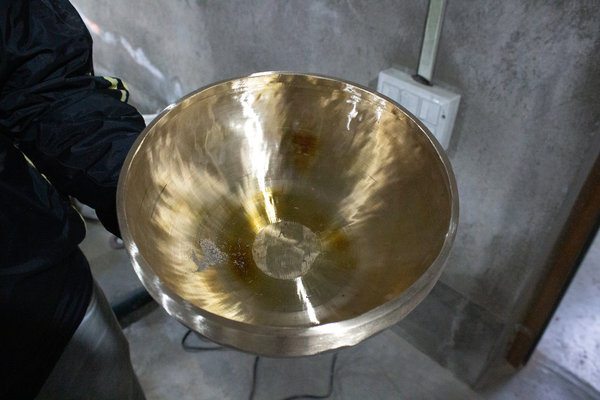
Finally, the singing bowls are polished, giving them their smooth, shiny surface.

Tradition Craftsmanship: Each Singing Bowl is Unique
Our metal singing bowls are handcrafted using traditional forging techniques, resulting in natural dark spots due to the intense heat and individual shaping. These marks of true craftsmanship reflect the handmade nature of the bowls and make each one entirely unique. No two bowls are the same - each has its own story and carries the character of the artisan who created it. The sound quality, functionality, and energetic impact of your bowl remains unaffected. These unique features emphasize that this is not a mass-produced item but a one-of-a-kind piece made with dedication and care.
Different Ways of Playing Singing Bowls
Singing bowls can be played in various ways. The two main methods are striking and rubbing the bowl. Both produce different sounds and effects.

Striking the bowl
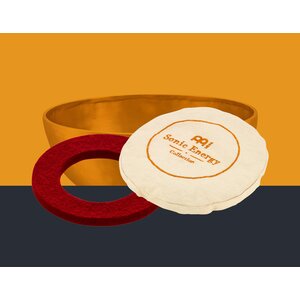
To strike a singing bowl, place it on your flat, outstretched hand, a cushion, or a felt ring.
Hold the mallet parallel to the rim and gently strike the bowl just below the edge.
This can also be done with a slight upward motion to produce a clear, pleasant tone and a noticeable vibration throughout the body.

Rubbing the bowl
When rubbing, the mallet is guided along the rim of the singing bowl with light pressure. The steady, circular motion causes the bowl to begin to “sing.”
Only minimal pressure is required, and the tone gradually becomes stronger the longer the motion is maintained. This technique requires a bit more practice and patience, as both the pressure and speed must be carefully controlled to produce a consistent, sustained tone.
To deepen the sound, the bowl can be struck before rubbing it.

Influence of the mallet
In addition to the playing technique and the type of singing bowl, the choice of mallet also has a significant impact on the sound.
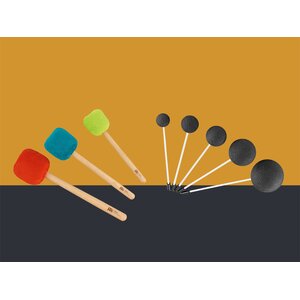
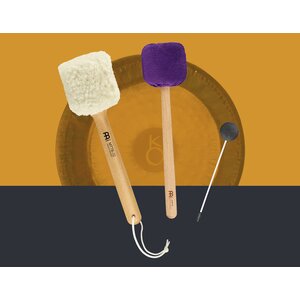
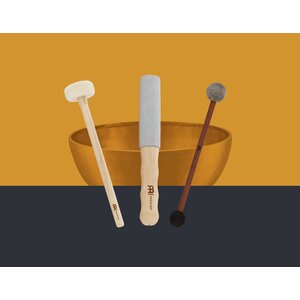
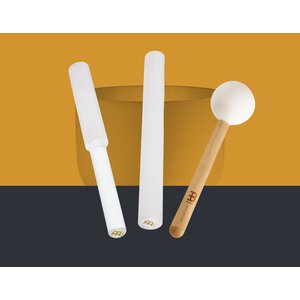
Soft mallets tend to emphasize the fundamental tone, producing a warm, deep sound. Harder mallets, on the other hand, bring out the overtones and create a clearer, more defined sound. You can find an overview of our mallets here:
By combining different mallets, a wide range of sound variations can be achieved and tailored to the intended application.
Differences Among the Meinl Sonic Energy Singing Bowl Series
Meinl Sonic Energy offers a wide range of singing bowls that vary in size, shape, wall thickness, and tonal character.
Larger singing bowls generally produce deeper tones, while smaller bowls produce higher-pitched tones. The shape and wall thickness influence the resonance, the richness of the overtones, and the projection of the sound. Each series is designed with specific sound characteristics and applications in mind.
Universal Series

Universal Singing Bowls are characterized by a straight rim and a well-balanced sound profile. When gently struck, they produce a clear, stable fundamental tone accompanied by harmonious overtones.
The sound unfolds evenly throughout the space and features a long, controlled sustain. This makes these singing bowls suitable for a wide range of applications, such as meditation, yoga, and mindfulness practices. Bowls of this series are mainly made for striking. However, bowls weighing around 1,000 g or more can also be played by rubbing the rim, producing a stable and sustained singing tone.
The Universal Series includes smaller bowls starting at around 500 g, as well as larger models weighing up to approximately 2,300 g. They can be played individually or combined as a set to create a pleasant and harmonious sound atmosphere.
Cosmos Therapy Series

Cosmos Therapy Singing Bowls feature a more rounded, fuller shape with a slightly inward-curved rim, created through additional hammering.
When gently struck or rubbed, they produce a powerful, long-lasting fundamental tone accompanied by soft, smooth overtones. Their round shape allows vibrations to be sustained longer, resulting in a particularly resonant and long-lasting sound.
This series has been specifically developed for professional use in meditation and sound therapy. With their deep and stable sound, they have a particularly calming and grounding effect.
The singing bowls in this series range from approximately 250 g to 2,000 g and can be used individually or combined as a set.
Energy Therapy Series

Energy Therapy Singing Bowls are characterized by a thicker rim and a more open shape.
When gently struck or rubbed, they produce powerful, vibrant overtones accompanied by soft fundamental tones. The sound has an energizing and revitalizing effect.
Depending on their size, these bowls are suitable for sound massage applications on both the upper and lower areas of the body. They are particularly effective when used in combination with a resonance mallet.
This series includes singing bowls ranging from approximately 700 g to 2,750 g. Smaller models are typically used for the upper body, while larger bowls are better suited for applications on the lower body.
Grounding Series

Grounding Singing Bowls are the largest models in the Meinl Sonic Energy range and have been specifically developed for sound therapy applications.
Due to their size, they produce deep, powerful tones with strong vibrations and an exceptionally long sustain. They are ideal for structuring sound sessions and creating a stable acoustic foundation.
A distinctive feature of this series is the ability to stand inside the singing bowl while it is being played. This allows the vibrations to be experienced directly throughout the entire body.
The Grounding Series starts at approximately 5,000 g and extends up to 15,000 g.
Origin Series

Origin Singing Bowls feature an untreated, unpolished surface that preserves their natural and original character. Their appearance is inspired by traditional singing bowls and conveys a particularly authentic aesthetic.
When gently struck, they produce a complex and expressive sound, ranging from strong fundamental tones to vibrant overtones. The sustain is long and intense, allowing the sound to fully develop within the space.
This type of singing bowl is well suited for yoga and meditation practices.
The Origin Series includes models ranging from approximately 600 g to 900 g.
Buying Guide: Which Singing Bowl Is Right for You?
Choosing the right singing bowl mainly depends on how and where it will be used. Especially for beginners, the wide range of options can initially feel overwhelming.
For Beginners

For beginners, we typically recommend a singing bowl from the Universal Series. Thanks to its well-balanced sound character, it is particularly versatile in use. It also provides an ideal and affordable introduction to the world of singing bowls.
To get started, a single singing bowl is usually sufficient. Over time, those who wish to create greater sound variety can combine multiple bowls to build a harmonious soundscape.
Within each series, we offer carefully curated sets that are perfectly matched in sound. These sets are designed to meet different needs and are available in a variety of sizes.
For specific applications

Depending on the desired effect, other series may also be a better choice:
Cosmos Therapy Series: for calm, meditative applications with a particularly deep and grounding sound
Energy Therapy Series: for more activating sound work with rich overtones and vibrant tonal characteristics
Grounding Series: for professional sound therapy, producing deep tones and an exceptionally long sustain
Origin Series: ideal for yoga and meditation, offering a particularly natural and characterful sound
Explore Our Singing Bowl Collection
Discover the full range of Meinl Sonic Energy singing bowls and find the model that best suits your needs.

Universal Series
- Straight rim with a well-balanced sound profile
- Clear fundamental tones with harmonious overtones
- Versatile for meditation, yoga, and mindfulness
- Ideal for beginners

Cosmos Therapy Series
- Rounded shape with a slightly inward-curved rim
- Deep, powerful fundamental tones with gentle overtones
- Long-lasting resonance and grounding sound
- Designed for meditation and sound therapy

Energy Therapy Series
- Thicker rim and more open shape
- Powerful overtones accompanied by gentle fundamental tones
- Energizing and activating effect
- Suitable for sound massage applications on the upper and lower body

Grounding Series
- Largest bowls with deep, powerful tones
- Strong vibrations with very long sustain
- Ideal for structuring sound sessions
- Full-body experience (can be stood in)

Origin Series
- Unpolished surface with a natural look
- Traditional and authentic appearance
- Complex, expressive sound
- Ideal for yoga and meditation
Still unsure which singing bowl is right for you?
Every singing bowl has its own unique character and sound. If you need help finding the right bowl for your personal practice or professional work, feel free to get in touch with us. Our team will be happy to provide personal recommendations and answer your questions.
Sources:
1 Аврамова, Я. (2026, February 12). The Origin of Singing Bowls: History, Journey, and Sound. The Science Of Sound. https://soundcups.com/en/the-origin-of-tibetan-singing-bowls-history-journey-and-sound
2 Fohmann, L. (2025, December 16). Tibetische Klangschalen – Herkunft, Nutzen und Wirkung in der Meditation. Feng Dzi. https://www.feng-dzi.de/post/tibetische-klangschalen-herkunft-nutzen-und-wirkung-in-der-meditation
3 Brown, C. G. (2019). Tibetan Singing Bowls. American religion, 1(2), 52-73.
4 Terwagne, D., & Bush, J. W. (2011). Tibetan singing bowls. Nonlinearity, 24(8), R51-R66.
5 Humphries, K. (2010). Healing Sound: Contemporary methods for Tibetan singing bowls.
6 Serwene, M. (2026, March 18). Klangschalen: Kompletter Ratgeber zu Wirkung, Arten & Anwendung des Instruments. Handpan-Portal. https://handpan-portal.de/klangschalen/
7 Seetharaman, R., Avhad, S. & Rane, J. (2023). Exploring the healing power of singing bowls: An overview of key findings and potential benefits. EXPLORE, 20(1), 39–43. https://doi.org/10.1016/j.explore.2023.07.007


